

There’s a story behind every woman working in IR. This September, as part of the Women in Medicine month, we are happy to offer you an insight into their inspiring journeys – if you’d like to participate in an Women in IR interview or you’d like to recommend someone to be interviewed, please contact us for more information.
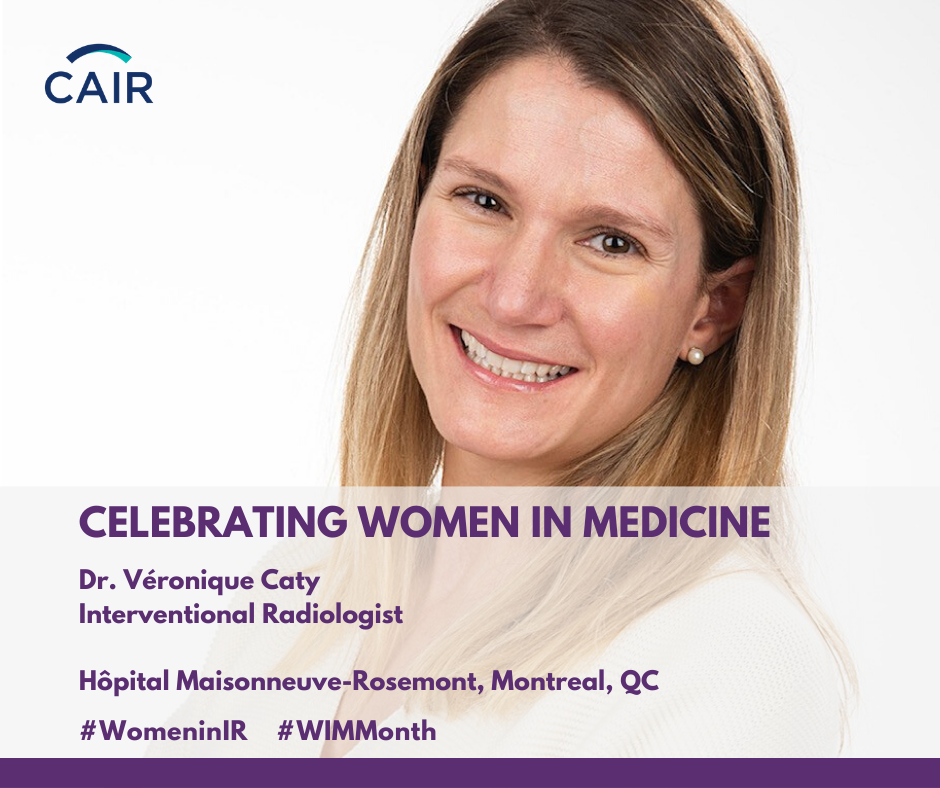

Dr. Véronique Caty finished her radiology residency at Université de Montréal in 2010. She completed the first year of fellowship at the Centre Hospitalier Universitaire de Montréal, (CHUM). She then continued her post graduate training in the Bay Area, California, at El Camino Hospital. She has been working at Hôpital Maisonneuve-Rosemont in Montreal (CIUSSS de l’est) since 2012. Her clinical interests include: dialysis access, venous insufficiency, percutaneous tumor ablation, fibromas and prostate embolization. She is involved with resident and fellow training. She has been a part of CAIR board since 2018 and is actively committed to interventional radiology advocacy to peers and patients.


What brought you to interventional radiology?

When I was studying medicine, I was not sure which field I wanted to go in. My interests were varied. I did a rotation in interventional radiology just before my residency match and I knew this is what I wanted to do. Hands on specialty at the bleeding edge of technology and minimally invasive procedures are the way to the future. I wanted to be a part of it.

What is one remarkable moment/achievement in your career?

I was honored to be asked to be a CAIR board member. A lot of IR professionals I look up to were previously part of the board or still are. I am so glad I can participate to promote interventional radiology across Canada.

What is one thing that is exciting about the future of IR?

Everything! Many procedures are shifting towards minimally invasive interventions. Especially with cancer treatments, the IR progress made in the last 10-15 years has been amazing. Interventionists are also more involved in the clinical care of patients which is so rewarding. We just need to make the public know these possibilities exist.

Any hobbies, what do enjoy doing outside of work?

I love to do sports with my family. We did a lot of cycling this summer. And as soon as snow will come, I will hit the slopes for downhill skiing. I also love to read books and let’s admit it, relax with a good movie or television series. I am trying to learn piano, I wish I stuck to lessons when I was younger – it is a lot of work to learn to play an instrument later in life.

Anecdote

My oldest daughter is 7 years old and talks a lot these days about what she wants to do when she is older. She told me: ‘I do not know what career I will choose, but I know I do not want to work during weekends like you’ to which I responded: ‘I wish for you to choose a path in which you will not mind putting in hours because it will mean you are in the right place.’ That is what IR is for me.

Chaque femme en RI a son histoire. En ce mois de septembre, mois des Femmes en médecine (Women in Medicine), nous vous proposons d’en apprendre un peu plus sur leur parcours inspirant. Si vous aimeriez participer à une entrevue Femmes en RI ou nous suggérer le nom d’une collègue à interviewer, n’hésitez pas à nous contacter.

There's a story behind every woman working in IR. This September, as part of the Women in Medicine month, we are happy to offer you an insight into their inspiring journeys - if you'd like to participate in an Women in IR interview or you'd like to recommend someone to be interviewed, please contact us for more information.

A draft presentation of no more than 8-10minutes should be submitted by October 7, 2020 via email at cairservice@cairweb.ca

Hosted* via Zoom, this inaugural meeting will take place on October 28, 2020 at 8:00 PM EST and include presentations** and discussions from residents and fellows enrolled in a radiology program in Canada.

A common service for dialysis patients costs about $100,000 less when delivered by an interventional radiologist rather than a surgeon, according to study published Tuesday.

Hosted by Dr. Jason Wong and Dr. Amol Mujoomdar via Zoom, this second meeting will take place on September 30, 2020 at 8:00 PM EST and include presentations from Interventional Radiologists from across Canada. Each presentation will be followed by a discussion (15 min/case).

Document for Medtech Company Representative and Health Care Facilities

Our hospital, one of NYC's public hospitals and a level 1 trauma centre, was transformed. Normally empty stretchers lining the halls and back corridors of the ER soon overflowed with COVID-19 patients. The public health system quickly nearly tripled its existing ICU capacity.

This COVID pandemic has shown us how an organization can step up and give a remarkable display of innovation, collaboration, dedication, decision-making, service reconfiguration and workforce re-design.

The strength of CAIR is in our members, and it is through membership and engaged members that CAIR is able to advance our profession.
There’s a story behind every woman working in IR. This September, as part of the Women in Medicine month, we are happy to offer you an insight into their inspiring journeys – if you’d like to participate in an Women in IR interview or you’d like to recommend someone to be interviewed, please contact us for more information.


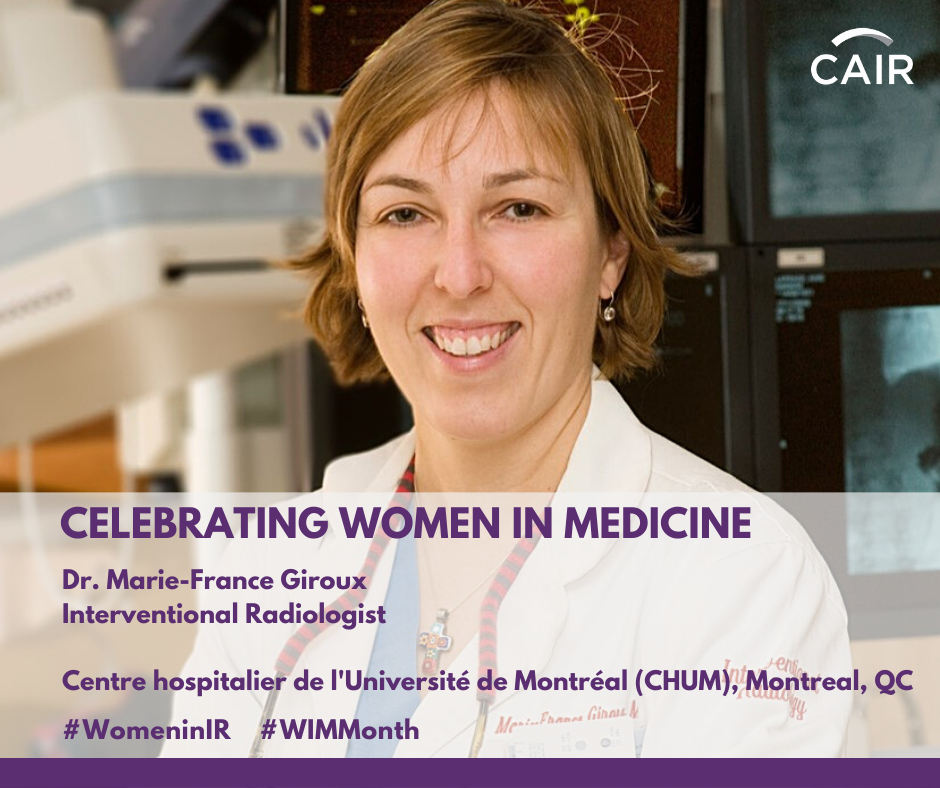
Dr. Marie-France Giroux studied medicine at the Université de Sherbrooke from 1991 to 1995. She then undertook her residency in diagnostic radiology at the Université de Montréal in 1995 and finished in 2000, followed by a fellowship in interventional and vascular radiology in 2001 at the Hospital of the University of Pennsylvania in Philadelphia. She completed her medical training in Bordeaux, France, where she underwent a specialized Doppler training program in 2001.

Dr. Giroux has been practising since 2001 at the Centre hospitalier universitaire de Montréal (CHUM), and was appointed associate professor in 2011. She developed a clinical mentoring program (fellowship) in interventional radiology at the CHUM.

From 2003 to 2013, Dr. Giroux was an active member of the Canadian Association for Interventional Radiology (CAIR) Board of Directors. Moreover, from 2007 to 2009, she was CAIR’s first woman president of the board. Through her efforts and those of her fellow directors, interventional radiology was recognized as a subspeciality in Canada in 2015.


What brought you to interventional radiology?

It is funny how people end up where they are; when I entered medical school, I wanted to become an orthopedic surgeon or a neurosurgeon. When I was in medical school, I met an orthopedic surgeon who hated his job and told me never to do orthopedic surgery, and I did not like the outcomes of neurosurgery patients. I stumbled upon a radiologist and he was so passionate about his work that I decided it was what I wanted to do. Then, when I was an R2, interventional radiologists did all the drainages and biopsies. One day, when Dr. Oliva was on service, he walked  me through a liver biopsy and I instantly fell in love with the field. I loved the brain part and technical parts of IR.

What is one thing that is exciting about the future of IR?

The field of Interventional Radiology is an ever-expanding field, we are constantly discovering new ways to solve problems. Oncology for example was a restricted field in IR that only blossomed and made a staggering progress in the past15 years.

What are some of the challenges women working in IR are facing?

The most challenging part of being a woman pursuing a career in IR is lack of time. There is a certain difficulty in balancing personal life with career. This is why it is so important to have role models that can be looked up to and get inspired by.

When I was a fellow, I was doing a procedure with an attending who was male. We suddenly heard the woman breathe heavily, the attendings immediately thought about allergic reaction and asked the technologist to five the patient a dose of Benadryl.  I decided to go and see the patient beforehand, and she told me she was very anxious. After talking to her and comforting her, she calmed down, and of course, did not need the Benadryl. My attendings later told me: “We really need a woman in our team! Having a different perspective is sure to improve the service we give to our patients.”

Any hobbies, what do enjoy doing outside of work?

We are a family of downhill skiers, and we will go almost every week-end during the cold season. We also enjoy wind surfing and mountain biking. It is always great to spend energy outside of work and spend time with family. I also enjoy playing the piano.

Chaque femme en RI a son histoire. En ce mois de septembre, mois des Femmes en médecine (Women in Medicine), nous vous proposons d’en apprendre un peu plus sur leur parcours inspirant. Si vous aimeriez participer à une entrevue Femmes en RI ou nous suggérer le nom d’une collègue à interviewer, n’hésitez pas à nous contacter.

There's a story behind every woman working in IR. This September, as part of the Women in Medicine month, we are happy to offer you an insight into their inspiring journeys - if you'd like to participate in an Women in IR interview or you'd like to recommend someone to be interviewed, please contact us for more information.

A draft presentation of no more than 8-10minutes should be submitted by October 7, 2020 via email at cairservice@cairweb.ca

Hosted* via Zoom, this inaugural meeting will take place on October 28, 2020 at 8:00 PM EST and include presentations** and discussions from residents and fellows enrolled in a radiology program in Canada.

A common service for dialysis patients costs about $100,000 less when delivered by an interventional radiologist rather than a surgeon, according to study published Tuesday.

Hosted by Dr. Jason Wong and Dr. Amol Mujoomdar via Zoom, this second meeting will take place on September 30, 2020 at 8:00 PM EST and include presentations from Interventional Radiologists from across Canada. Each presentation will be followed by a discussion (15 min/case).

Document for Medtech Company Representative and Health Care Facilities

Our hospital, one of NYC's public hospitals and a level 1 trauma centre, was transformed. Normally empty stretchers lining the halls and back corridors of the ER soon overflowed with COVID-19 patients. The public health system quickly nearly tripled its existing ICU capacity.

This COVID pandemic has shown us how an organization can step up and give a remarkable display of innovation, collaboration, dedication, decision-making, service reconfiguration and workforce re-design.

The strength of CAIR is in our members, and it is through membership and engaged members that CAIR is able to advance our profession.

Residents, Fellows, And Students Virtual Angio Club

Hosted* via Zoom, this inaugural meeting will take place on October 28, 2020 at 8:00 PM EST and include presentations** and discussions from residents and fellows enrolled in a radiology program in Canada.

Who can attend: everyone interested in Interventional Radiology (medical students, residents, fellows, faculty members, etc.)

This event is offered at no cost for all CAIR members!

Non-members: $59/year*** 

Limited space available.

*please note the event is offered in English only
**French and English presentations will be considered
***complimentary access/no charge for the October meeting


Who can submit a case : residents and fellows enrolled in a radiology program across Canada and who are members in good standing with CAIR.

Case criteria: 

  • Presentation must be targeted to an audience with little to moderate knowledge of IR
  • Educational value of presentation will be favored over complexity/rarity of the case
  • The recommended file type to be used for presentations is PowerPoint or Portable Document Format (PDF)

A draft presentation of no more than 8-10minutes should be submitted by October 7, 2020 via email at cairservice@cairweb.ca

Chaque femme en RI a son histoire. En ce mois de septembre, mois des Femmes en médecine (Women in Medicine), nous vous proposons d’en apprendre un peu plus sur leur parcours inspirant. Si vous aimeriez participer à une entrevue Femmes en RI ou nous suggérer le nom d’une collègue à interviewer, n’hésitez pas à nous contacter.

There's a story behind every woman working in IR. This September, as part of the Women in Medicine month, we are happy to offer you an insight into their inspiring journeys - if you'd like to participate in an Women in IR interview or you'd like to recommend someone to be interviewed, please contact us for more information.

A draft presentation of no more than 8-10minutes should be submitted by October 7, 2020 via email at cairservice@cairweb.ca

Hosted* via Zoom, this inaugural meeting will take place on October 28, 2020 at 8:00 PM EST and include presentations** and discussions from residents and fellows enrolled in a radiology program in Canada.

A common service for dialysis patients costs about $100,000 less when delivered by an interventional radiologist rather than a surgeon, according to study published Tuesday.

Hosted by Dr. Jason Wong and Dr. Amol Mujoomdar via Zoom, this second meeting will take place on September 30, 2020 at 8:00 PM EST and include presentations from Interventional Radiologists from across Canada. Each presentation will be followed by a discussion (15 min/case).

Document for Medtech Company Representative and Health Care Facilities

Our hospital, one of NYC's public hospitals and a level 1 trauma centre, was transformed. Normally empty stretchers lining the halls and back corridors of the ER soon overflowed with COVID-19 patients. The public health system quickly nearly tripled its existing ICU capacity.

This COVID pandemic has shown us how an organization can step up and give a remarkable display of innovation, collaboration, dedication, decision-making, service reconfiguration and workforce re-design.

The strength of CAIR is in our members, and it is through membership and engaged members that CAIR is able to advance our profession.

Hosted* via Zoom, this inaugural meeting will take place on October 28, 2020 at 8:00 PM EST and include presentations** and discussions from residents and fellows enrolled in a radiology program in Canada.

Who can attend: everyone interested in Interventional Radiology (medical students, residents, fellows, faculty members, etc.)

*please note the event is offered in English only
**French and English presentations will be considered


CAIR MEMBERS

This event is offered at NO COST for CAIR members. Please note that you need to log into your account first and select “Register for Events” link  (left side menu) in the member dashboard to get the member rate. A separate registration to the Zoom platform will follow and you will receive an email with the meeting registration details.

CAIR NON-MEMBERS: $59.00+tax

This fee includes all sessions for 2020. (complimentary access/no charge for the October meeting)

To register, add item to cart and then proceed to check out. Follow instructions to fill out personal and payment information. A confirmation email will be sent once the payment is processed. A separate registration to the Zoom platform will follow and you will receive an email with the meeting registration details.

NOT A MEMBER YET?

CAIR membership has many benefits, to join – apply here.

$59.00Add to cart

Chaque femme en RI a son histoire. En ce mois de septembre, mois des Femmes en médecine (Women in Medicine), nous vous proposons d’en apprendre un peu plus sur leur parcours inspirant. Si vous aimeriez participer à une entrevue Femmes en RI ou nous suggérer le nom d’une collègue à interviewer, n’hésitez pas à nous contacter.

There's a story behind every woman working in IR. This September, as part of the Women in Medicine month, we are happy to offer you an insight into their inspiring journeys - if you'd like to participate in an Women in IR interview or you'd like to recommend someone to be interviewed, please contact us for more information.

A draft presentation of no more than 8-10minutes should be submitted by October 7, 2020 via email at cairservice@cairweb.ca

Hosted* via Zoom, this inaugural meeting will take place on October 28, 2020 at 8:00 PM EST and include presentations** and discussions from residents and fellows enrolled in a radiology program in Canada.

A common service for dialysis patients costs about $100,000 less when delivered by an interventional radiologist rather than a surgeon, according to study published Tuesday.

Hosted by Dr. Jason Wong and Dr. Amol Mujoomdar via Zoom, this second meeting will take place on September 30, 2020 at 8:00 PM EST and include presentations from Interventional Radiologists from across Canada. Each presentation will be followed by a discussion (15 min/case).

Document for Medtech Company Representative and Health Care Facilities

Our hospital, one of NYC's public hospitals and a level 1 trauma centre, was transformed. Normally empty stretchers lining the halls and back corridors of the ER soon overflowed with COVID-19 patients. The public health system quickly nearly tripled its existing ICU capacity.

This COVID pandemic has shown us how an organization can step up and give a remarkable display of innovation, collaboration, dedication, decision-making, service reconfiguration and workforce re-design.

The strength of CAIR is in our members, and it is through membership and engaged members that CAIR is able to advance our profession.

A common service for dialysis patients costs about $100,000 less when delivered by an interventional radiologist rather than a surgeon, according to study published Tuesday.

More than 600,000 patients each year require life-saving hemodialysis for end-stage renal disease. And such care is a costly proposition, with $34 billion spent each year in fee-for-service Medicare, largely for creating and maintaining conduits, noted experts with the University of Colorado.

Fewer than 50% of all access conduits for dialysis remain viable for longer than three years and clinical guidelines recommend regular surveillance to guard for signs of impending failure. Interventions such as angiography, angioplasty stent placement and thrombolysis are typically performed by radiologists, surgeons or nephrologists. But it appears that interventional imaging physicians’ work in this realm costs tens of thousands less, underlining the subspecialty’s value proposition, and an opportunity to save significantly in the Medicare program, experts advised.

On average, the cost per patency year of dialysis in Medicare landed at roughly $174,000 for surgeons compared to $89,000 for nephrologists and $71,000 for radiologists.

To read more, access the article here, courtesy of the Radiology Business.

Chaque femme en RI a son histoire. En ce mois de septembre, mois des Femmes en médecine (Women in Medicine), nous vous proposons d’en apprendre un peu plus sur leur parcours inspirant. Si vous aimeriez participer à une entrevue Femmes en RI ou nous suggérer le nom d’une collègue à interviewer, n’hésitez pas à nous contacter.

There's a story behind every woman working in IR. This September, as part of the Women in Medicine month, we are happy to offer you an insight into their inspiring journeys - if you'd like to participate in an Women in IR interview or you'd like to recommend someone to be interviewed, please contact us for more information.

A draft presentation of no more than 8-10minutes should be submitted by October 7, 2020 via email at cairservice@cairweb.ca

Hosted* via Zoom, this inaugural meeting will take place on October 28, 2020 at 8:00 PM EST and include presentations** and discussions from residents and fellows enrolled in a radiology program in Canada.

A common service for dialysis patients costs about $100,000 less when delivered by an interventional radiologist rather than a surgeon, according to study published Tuesday.

Hosted by Dr. Jason Wong and Dr. Amol Mujoomdar via Zoom, this second meeting will take place on September 30, 2020 at 8:00 PM EST and include presentations from Interventional Radiologists from across Canada. Each presentation will be followed by a discussion (15 min/case).

Document for Medtech Company Representative and Health Care Facilities

Our hospital, one of NYC's public hospitals and a level 1 trauma centre, was transformed. Normally empty stretchers lining the halls and back corridors of the ER soon overflowed with COVID-19 patients. The public health system quickly nearly tripled its existing ICU capacity.

This COVID pandemic has shown us how an organization can step up and give a remarkable display of innovation, collaboration, dedication, decision-making, service reconfiguration and workforce re-design.

The strength of CAIR is in our members, and it is through membership and engaged members that CAIR is able to advance our profession.

Hosted by Dr. Jason Wong and Dr. Amol Mujoomdar via Zoom, this second meeting will take place on September 30, 2020 at 8:00 PM EST and include presentations from Interventional Radiologists from across Canada. Each presentation will be followed by a discussion (15 min/case).


CAIR MEMBERS

This event is offered at NO COST for CAIR members.  Please note that you need to log into your account first and select “Register for Events” link (left side menu) in the member dashboard to get the member rate. A separate registration to the Zoom platform will follow and you will receive an email with the meeting registration details.

CAIR NON-MEMBERS: $199.00 + tax

This fee includes all sessions for 2020.

To register, add item to cart and then proceed to check out. Follow instructions to fill out personal and payment information. A confirmation email will be sent once the payment is processed. A separate registration to the Zoom platform will follow and you will receive an email with the meeting registration details.


Chaque femme en RI a son histoire. En ce mois de septembre, mois des Femmes en médecine (Women in Medicine), nous vous proposons d’en apprendre un peu plus sur leur parcours inspirant. Si vous aimeriez participer à une entrevue Femmes en RI ou nous suggérer le nom d’une collègue à interviewer, n’hésitez pas à nous contacter.

There's a story behind every woman working in IR. This September, as part of the Women in Medicine month, we are happy to offer you an insight into their inspiring journeys - if you'd like to participate in an Women in IR interview or you'd like to recommend someone to be interviewed, please contact us for more information.

A draft presentation of no more than 8-10minutes should be submitted by October 7, 2020 via email at cairservice@cairweb.ca

Hosted* via Zoom, this inaugural meeting will take place on October 28, 2020 at 8:00 PM EST and include presentations** and discussions from residents and fellows enrolled in a radiology program in Canada.

A common service for dialysis patients costs about $100,000 less when delivered by an interventional radiologist rather than a surgeon, according to study published Tuesday.

Hosted by Dr. Jason Wong and Dr. Amol Mujoomdar via Zoom, this second meeting will take place on September 30, 2020 at 8:00 PM EST and include presentations from Interventional Radiologists from across Canada. Each presentation will be followed by a discussion (15 min/case).

Document for Medtech Company Representative and Health Care Facilities

Our hospital, one of NYC's public hospitals and a level 1 trauma centre, was transformed. Normally empty stretchers lining the halls and back corridors of the ER soon overflowed with COVID-19 patients. The public health system quickly nearly tripled its existing ICU capacity.

This COVID pandemic has shown us how an organization can step up and give a remarkable display of innovation, collaboration, dedication, decision-making, service reconfiguration and workforce re-design.

The strength of CAIR is in our members, and it is through membership and engaged members that CAIR is able to advance our profession.

In response to the COVID-19 pandemic, hospitals and surgical facilities nationwide paused elective surgical procedures and other non-emergent and non-essential services, limiting physical access to health care facilities for non-essential health care personnel, patient visitors, and medical technology representatives.

Medtech Canada (the association representing the medical technology industry in Canada) developed the following Re-entry Guidance document (link below), which provides clinically based recommendations to support health care organizations and medical technology representatives when resuming elective procedures.

The principles and considerations contained in the document are intended to guide health care facilities, health care personnel and medical technology representatives as they adopt access policies that support safe re-entry of medical technology representatives into the health care facility. These considerations are not a substitute for guidance or requirements from provincial or federal government authorities.

Medtech Canada will be disseminating the document to its relevant stakeholders through the association’s various committees, and they sought endorsements from medical groups to support the document. 

CAIR is pleased to support this guidance document, as it will assist in ensuring that industry representatives can continue to support clinicians in a safe and responsive way.

Re-entry Guidance for Health Care Facilities and Medical Technology Representatives

If you have any questions about the Re-entry Guidance, please contact Medtech Canada’s President and CEO, Brian Lewis at blewis@medtechcanada.org.


Chaque femme en RI a son histoire. En ce mois de septembre, mois des Femmes en médecine (Women in Medicine), nous vous proposons d’en apprendre un peu plus sur leur parcours inspirant. Si vous aimeriez participer à une entrevue Femmes en RI ou nous suggérer le nom d’une collègue à interviewer, n’hésitez pas à nous contacter.

There's a story behind every woman working in IR. This September, as part of the Women in Medicine month, we are happy to offer you an insight into their inspiring journeys - if you'd like to participate in an Women in IR interview or you'd like to recommend someone to be interviewed, please contact us for more information.

A draft presentation of no more than 8-10minutes should be submitted by October 7, 2020 via email at cairservice@cairweb.ca

Hosted* via Zoom, this inaugural meeting will take place on October 28, 2020 at 8:00 PM EST and include presentations** and discussions from residents and fellows enrolled in a radiology program in Canada.

A common service for dialysis patients costs about $100,000 less when delivered by an interventional radiologist rather than a surgeon, according to study published Tuesday.

Hosted by Dr. Jason Wong and Dr. Amol Mujoomdar via Zoom, this second meeting will take place on September 30, 2020 at 8:00 PM EST and include presentations from Interventional Radiologists from across Canada. Each presentation will be followed by a discussion (15 min/case).

Document for Medtech Company Representative and Health Care Facilities

Our hospital, one of NYC's public hospitals and a level 1 trauma centre, was transformed. Normally empty stretchers lining the halls and back corridors of the ER soon overflowed with COVID-19 patients. The public health system quickly nearly tripled its existing ICU capacity.

This COVID pandemic has shown us how an organization can step up and give a remarkable display of innovation, collaboration, dedication, decision-making, service reconfiguration and workforce re-design.

The strength of CAIR is in our members, and it is through membership and engaged members that CAIR is able to advance our profession.

It was a Saturday in mid March. I sat down in the back of the IR control room, and I began dictating chest radiographs from the ER. The first one demonstrated subtle hazy peripheral opacities. It was not garden variety bacterial pneumonia. I called the ER attending, “I am concerned this is COVID-19.” The next chest radiograph showed peripheral, ill-defined, bilateral airspace opacities. I called the ER

 attending again. One after the other, I began to feel like a broken record with my dictations, and phone calls. On CTs of the abdomen and pelvis performed to rule out nephrolithiasis, diverticulitis, etc… I was seeing bilateral, peripheral, ground glass opacities in patients who were otherwise asymptomatic from a respiratory perspective. I picked up the phone again: “No stone, no diverticulitis, but I’m worried they have COVID-19.”

Prior to this, we had seen probably fewer than five suspicious cases at my hospital. On Monday, I followed up the COVID testing for those patients. They were all positive. The floodgates had opened, and COVID-19 came charging through.

Our hospital, one of NYC’s public hospitals and a level 1 trauma centre, was transformed. Normally empty stretchers lining the halls and back corridors of the ER soon overflowed with COVID-19 patients. The public health system quickly nearly tripled its existing ICU capacity. US Army doctors, nurses, and physician assistants answered the call of duty, and helped support us through this crisis by helping staff some of the new ICUs. Elective surgeries were postponed. We postponed doing elective IR cases.

In March, prior to the surge, my partner and I would go to the ICU and place central venous catheters and arterial lines on patients to help ease the burden on the ICU staff. With a program of four radiology residents per year, one resident was assigned to night float, and four covered various rotations simultaneously.
(more…)

Chaque femme en RI a son histoire. En ce mois de septembre, mois des Femmes en médecine (Women in Medicine), nous vous proposons d’en apprendre un peu plus sur leur parcours inspirant. Si vous aimeriez participer à une entrevue Femmes en RI ou nous suggérer le nom d’une collègue à interviewer, n’hésitez pas à nous contacter.

There's a story behind every woman working in IR. This September, as part of the Women in Medicine month, we are happy to offer you an insight into their inspiring journeys - if you'd like to participate in an Women in IR interview or you'd like to recommend someone to be interviewed, please contact us for more information.

A draft presentation of no more than 8-10minutes should be submitted by October 7, 2020 via email at cairservice@cairweb.ca

Hosted* via Zoom, this inaugural meeting will take place on October 28, 2020 at 8:00 PM EST and include presentations** and discussions from residents and fellows enrolled in a radiology program in Canada.

A common service for dialysis patients costs about $100,000 less when delivered by an interventional radiologist rather than a surgeon, according to study published Tuesday.

Hosted by Dr. Jason Wong and Dr. Amol Mujoomdar via Zoom, this second meeting will take place on September 30, 2020 at 8:00 PM EST and include presentations from Interventional Radiologists from across Canada. Each presentation will be followed by a discussion (15 min/case).

Document for Medtech Company Representative and Health Care Facilities

Our hospital, one of NYC's public hospitals and a level 1 trauma centre, was transformed. Normally empty stretchers lining the halls and back corridors of the ER soon overflowed with COVID-19 patients. The public health system quickly nearly tripled its existing ICU capacity.

This COVID pandemic has shown us how an organization can step up and give a remarkable display of innovation, collaboration, dedication, decision-making, service reconfiguration and workforce re-design.

The strength of CAIR is in our members, and it is through membership and engaged members that CAIR is able to advance our profession.

With an ordinary beginning to the year, little did I suspect a virus pandemic and a near future bleak reality awaiting. The earliest cases detected in the UK were in late January. Despite not belonging to any vulnerable group at that time, exaggerated media reports of young individuals rapidly deteriorating, requiring ventilator support and some even dying did cause fear in our minds. Unsurprisingly, crowding being the most common risk factor for spread, London soon saw exponential growth in its COVID-19 cases. Simple public health measures like frequent hand sanitising and avoiding frequent touching of the face failed to reduce the virus spread, and the increasing case load led to full blown lockdown in late March. The parliament of the UK granted the government emergency powers to handle the pandemic and police were empowered to enforce lockdown. Fear of disaster and supply shortage led to panic buying. The situation slowly started improving in May and the government is looking at gradually relaxing lockdown measures.

Major and drastic changes were made in the NHS. The health trust I work in is one of the five most affected trusts in the whole of UK. Diagnostic radiologists started working from home exclusively, including attending multidisciplinary meetings via online conferencing softwares. Interventional radiology services fell overnight to an emergency-only service. An experienced radiologist colleague was designated the Radiology COVID lead who collaborated with the other departments and hospital management to bring about necessary changes in Radiology to meet the demands of this pandemic. Vetting of planned cases and categorization into various classes of urgency and severity ensued. (more…)

Chaque femme en RI a son histoire. En ce mois de septembre, mois des Femmes en médecine (Women in Medicine), nous vous proposons d’en apprendre un peu plus sur leur parcours inspirant. Si vous aimeriez participer à une entrevue Femmes en RI ou nous suggérer le nom d’une collègue à interviewer, n’hésitez pas à nous contacter.

There's a story behind every woman working in IR. This September, as part of the Women in Medicine month, we are happy to offer you an insight into their inspiring journeys - if you'd like to participate in an Women in IR interview or you'd like to recommend someone to be interviewed, please contact us for more information.

A draft presentation of no more than 8-10minutes should be submitted by October 7, 2020 via email at cairservice@cairweb.ca

Hosted* via Zoom, this inaugural meeting will take place on October 28, 2020 at 8:00 PM EST and include presentations** and discussions from residents and fellows enrolled in a radiology program in Canada.

A common service for dialysis patients costs about $100,000 less when delivered by an interventional radiologist rather than a surgeon, according to study published Tuesday.

Hosted by Dr. Jason Wong and Dr. Amol Mujoomdar via Zoom, this second meeting will take place on September 30, 2020 at 8:00 PM EST and include presentations from Interventional Radiologists from across Canada. Each presentation will be followed by a discussion (15 min/case).

Document for Medtech Company Representative and Health Care Facilities

Our hospital, one of NYC's public hospitals and a level 1 trauma centre, was transformed. Normally empty stretchers lining the halls and back corridors of the ER soon overflowed with COVID-19 patients. The public health system quickly nearly tripled its existing ICU capacity.

This COVID pandemic has shown us how an organization can step up and give a remarkable display of innovation, collaboration, dedication, decision-making, service reconfiguration and workforce re-design.

The strength of CAIR is in our members, and it is through membership and engaged members that CAIR is able to advance our profession.

Dear members,

Looking back at 2019 it is, in some ways, like looking back on a different world. It was a world where CAIR brought together, face-to-face, so many IR professionals for important moments like the Annual Meeting, where we could sit down next to each other and where we could present, listen, and engage in real life. 

We made the difficult decision to cancel our 2020 event, but we continue to be grateful for the ongoing support and professionalism of our community of healthcare professionals, members, corporate partners, and other stakeholders.

As we look ahead, we realize that, though our methods of delivery may be different, our goals are still very much the same: providing value to our members by moving forward our scientific and educational offerings in a world where the COVID-19 pandemic continues to pose professional and personal demands to the IR community.

We must forge ahead with the important work of promoting IR and minimally invasive procedures to patients, patient advocacy groups, other health care professionals, and policy makers as part of the CAIR initiative.  New initiatives are underway: we have started a new Virtual Angio Club and a brand-new Residents, Fellows, and Students Section!

We also must face other realities. Over the past few weeks, we’ve been listening to the conversations taking place internally and worldwide on the topic of racial inequities experienced by Black people and their communities. The widespread protests against racial injustice and anti-Black violence have also showed us being at a crossroads for democracy and human rights not only south of the border but also here in Canada.

Around the world, health care organizations are declaring anti-Black racism a public health crisis. Here at CAIR, we have a commitment to equality and justice for all, zero tolerance for racism, bigotry and hate of any kind. Racism exists everywhere, including Canadian healthcare, and as health care professionals, we must commit to challenge it whenever we see it and strive to provide the highest attainable standard of healthcare as one of the fundamental rights of every human being. In addition, we must proclaim: Black Lives Matter.

More than ever, we now have a shared sense of purpose and commitment where health care professionals are compassionate and collaborative.

We have built a great team. In April, we welcomed Luciana Nechita as CAIR’s Executive Director. Under her leadership and along with the CAIR board, we’re looking forward to strengthening our vision to bring together the IR community and work with patient groups and other allies to help increase accessibility for Canadians to patient friendly, effective, minimally invasive, image guided treatments.

The strength of CAIR is in our members, and it is through membership and engaged members that CAIR is able to advance our profession.

2020, is it over yet?  Despite our new challenges, I look forward to our mission and to listening and working with you!

Take CAIR,

Amol Mujoomdar

Chaque femme en RI a son histoire. En ce mois de septembre, mois des Femmes en médecine (Women in Medicine), nous vous proposons d’en apprendre un peu plus sur leur parcours inspirant. Si vous aimeriez participer à une entrevue Femmes en RI ou nous suggérer le nom d’une collègue à interviewer, n’hésitez pas à nous contacter.

There's a story behind every woman working in IR. This September, as part of the Women in Medicine month, we are happy to offer you an insight into their inspiring journeys - if you'd like to participate in an Women in IR interview or you'd like to recommend someone to be interviewed, please contact us for more information.

A draft presentation of no more than 8-10minutes should be submitted by October 7, 2020 via email at cairservice@cairweb.ca

Hosted* via Zoom, this inaugural meeting will take place on October 28, 2020 at 8:00 PM EST and include presentations** and discussions from residents and fellows enrolled in a radiology program in Canada.

A common service for dialysis patients costs about $100,000 less when delivered by an interventional radiologist rather than a surgeon, according to study published Tuesday.

Hosted by Dr. Jason Wong and Dr. Amol Mujoomdar via Zoom, this second meeting will take place on September 30, 2020 at 8:00 PM EST and include presentations from Interventional Radiologists from across Canada. Each presentation will be followed by a discussion (15 min/case).

Document for Medtech Company Representative and Health Care Facilities

Our hospital, one of NYC's public hospitals and a level 1 trauma centre, was transformed. Normally empty stretchers lining the halls and back corridors of the ER soon overflowed with COVID-19 patients. The public health system quickly nearly tripled its existing ICU capacity.

This COVID pandemic has shown us how an organization can step up and give a remarkable display of innovation, collaboration, dedication, decision-making, service reconfiguration and workforce re-design.

The strength of CAIR is in our members, and it is through membership and engaged members that CAIR is able to advance our profession.